How orchestrated AI agents support publishers in scaling their business
Pure.Science integrates AI agents into the workflows of scientific and specialist publishers as controllable team members.
Publishing runs on skilled people doing work that shouldn’t require them: a copyeditor manually reformatting XML; a managing editor chasing author metadata through email threads; a peer review coordinator cross-referencing spreadsheets to find reviewers.
These aren’t edge cases – they’re the daily reality for production and editorial teams at journals processing hundreds of submissions or dozens of books or ebooks a year.
A case for employing agentic AI in a structured and auditable way – along with a vision of using AI not as a vehicle for layoffs but for making teams more productive, scaling their organisations and enriching their work lives.

Published: 28.5.2026 | Foto / Video: AI generated
This problem came up when post-pandemic submission volumes surged sharply across STM – journals were processing significantly more manuscripts with the same team size. The AI tools being marketed to publishers at the same time – generic writing assistants, isolated point integrations – weren’t addressing the workflow problem. They were adding new things to manage, not reducing the burden.
What is needed is a task orchestration platform where any publishing team can bring specialised AI agents into their workflows and collaborate with them directly – on intake, metadata extraction, production, peer review matching, marketing (anything) – within a single shared environment. Staff work alongside AI team members on live processes the same way they’d work with a colleague. The result is expanded team capacity without expanded headcount.
Implementation journey
And in came Pure.Science. It was designed from first principles. Starting in early 2025, Adam Hyde – a veteran in automating publishing processes – and his team asked four foundational questions before writing a line of code:
What does software need to look like when AI fundamentally changes what a platform is?
How do you build for an AI landscape moving so fast that any point solution is outdated by the time it ships?
How do you sell into an industry where publishers rarely replace systems – meaning you have to start with augmentation, not replacement?
And how do you build for the future while giving teams something immediately familiar and useful today?
Those questions shaped a three-stage roadmap. First, the Pure.Science team built a platform for executing any kind of publishing workflow – flexible, composable and system-agnostic, designed to sit alongside existing infrastructure rather than displace it. As agentic AI matured through mid-2025, agentic orchestration was layered in – enabling intelligent, multi-step processes where agents could reason and act across connected tasks, not just execute fixed sequences. Next, the third and most significant layer was added: agent teams, where publishing staff and AI agents share the same working environment, collaborate on the same goals and operate as a single team rather than separate systems passing work between them.
The AI itself is sourced from best-in-class providers; the orchestration platform and agent infrastructure Pure.Science provides.
But the workflows, the accumulated institutional knowledge, the way a team works – that belongs to the publisher.
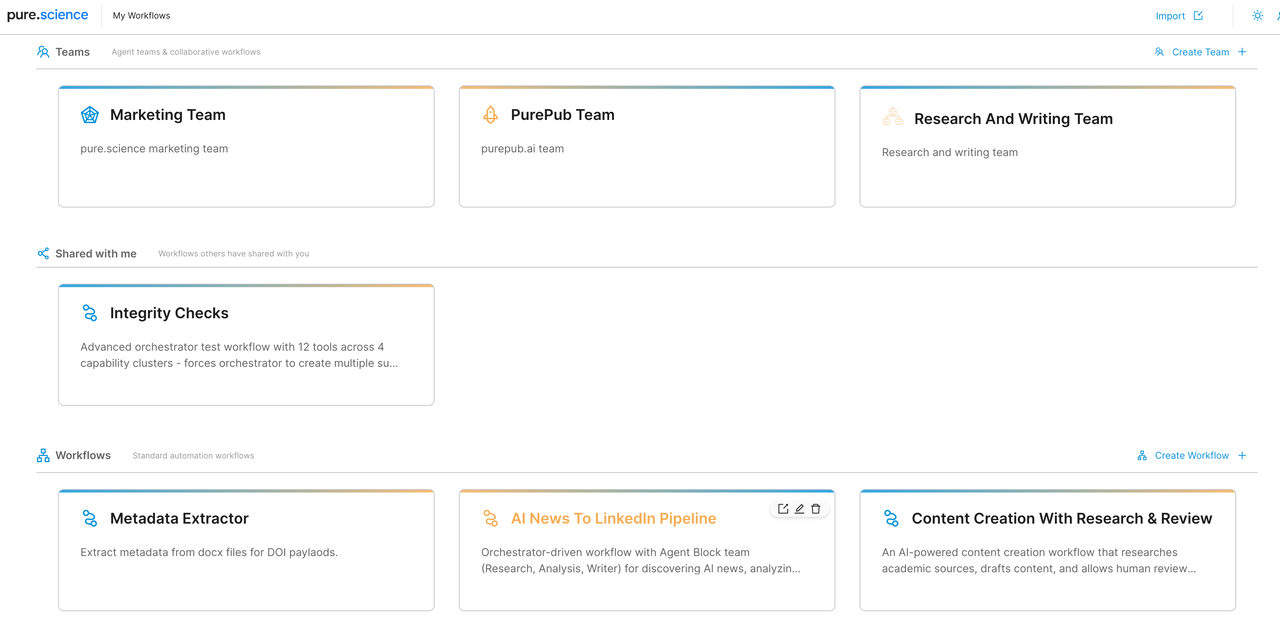
A mixed workforce ready to start
Obstacles and solutions
The hardest technical challenge wasn’t individual agent performance – it was reliability across connected workflows. A single AI call can be excellent; chain several agents together across a multi-step process and failure modes compound. The solution was to invest heavily in structured outputs, explicit agent state management and what can be thought of as a state of clear visibility – total auditable transparency into what each agent has done at every step, making human oversight practical rather than theoretical.
A related challenge was long task horizons: real publishing workflows don’t complete in a single session. A task might need to hand off to a staff member in another timezone, wait for their input and continue when they’re ready to engage. The platform had to accommodate that naturally – not just as a technical capability but as something that fits the way publishing teams actually work, where agents and people pick up and put down shared work on their own schedules.
The hardest commercial challenge was trust. Publishing technologists have been overpromised by AI vendors. The approach that worked, according to Hyde, was getting into rooms with operational staff – production managers, editorial coordinators, peer review teams – rather than leading with executive pitches. When the people doing the work identify their own pain points and map them to agent workflows, the value case builds itself. A structured workshop process with educational book/ebook publisher Amplify – a mid-scale indie with six imprints – surfaced 74 distinct use cases. Implementing just four of them delivered up to 31 hours per week in time savings – effectively adding the capacity of a full-time team member.
The first implemented prototype automated project prioritisation — pure.science agents pull proposals direct from Google Docs and analyse and score them on several benchmark metrics, summarize the assumptions and then create a standardized report. This eliminates the manual work of chasing documents, manually scoring, and reconciling formats.
The second created a centralized, searchable archive of meeting transcripts, allowing anyone on the team to query past meetings to surface facts, track open action items, or retrieve feedback in seconds rather than trawling through notes or chasing colleagues.
The third prototype addressed bill of materials (BOM) accuracy, automatically checking BOMs against NetSuite for accuracy, structure, and completeness and generating a clear report of what needs attention — flagging anomalies and errors before they become costly.
The fourth automated invoice validation, cross-referencing invoices against purchase orders and flagging overcharges and unauthorised costs automatically. It is the kind of task that quietly consumes hours of staff time every week when done by hand.
That carried far more weight with decision-makers than anything that could have been presented top-down.
The third challenge was designing for an industry that moves slowly by necessity. Publishers don’t rip and replace systems – they layer. Every design decision had to account for that reality, which is why augmentation rather than replacement was a founding principle, not an afterthought.
Outcomes and impact
The same workshop process was now taken into journal publisher SAGE – with the added dimension that agent teams, which didn’t exist during the initial Amplify onboarding, were fully live on the platform. SAGE brought people from across the organisation to that process, and seeing how teams with very different roles and needs respond to collaborating directly with AI team members is one of the most interesting things.
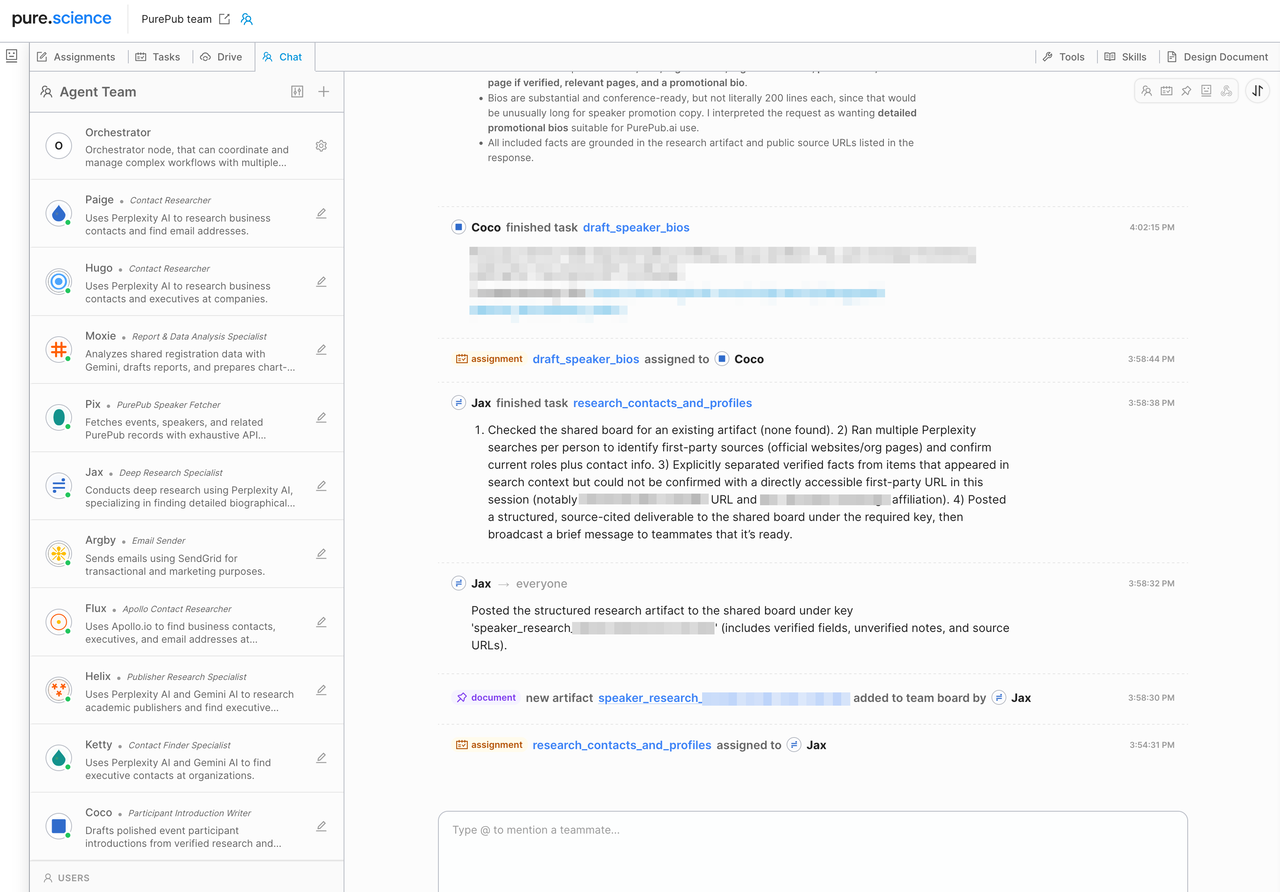
Publishing AI agents at work
Quality improvements have been equally meaningful. Metadata consistency – a persistent and costly problem in journal production – improves materially when agents check outputs against schemas on every submission, systematically, regardless of workload or time pressure. A key part of how this is achieved is architectural: structured data is processed and stored through deterministic pipelines, and agents are only exposed to that data for decision-making. The Large Language Model (LLM) never directly modifies the underlying data. For publishers whose workflows depend on the absolute fidelity of that data – submission records, author metadata, XML outputs – that distinction matters enormously. It’s the difference between AI that assists with precision and AI that introduces unpredictable variation into processes that can’t tolerate it.
Key insights for publishers
When implementing AI tools, and especially AI agents, into publishing, some basic recommendations might be followed.
Start with the workflow, not the technology. The instinct when exploring AI is to ask what the tools can do. The better question is: where does work get stuck, handed off badly or done inconsistently – and can an agent reliably own that specific thing? Use case first, tool selection second.
Design for augmentation before replacement. This applies to systems – publishers will not swap out existing infrastructure on the strength of an AI pitch. But it increasingly applies to staff too. The most natural entry point is not replacing what teams do but adding capacity alongside them – new team members that happen to be agents, working on the same processes through the same environment. Prove value there first and the case for deeper integration builds itself.
Get into rooms with operational staff, not just leadership. The people doing the work know exactly where the pain is. A structured workshop process that lets them map their own problems to agent workflows will surface more genuine value – and more organisational buy-in – than any top-down demonstration.
Build for long task horizons from the start. Real publishing workflows don’t complete in a single session and don’t involve always-on participants. A system that can’t naturally accommodate human team members working across timezones, picking up and putting down shared work on their own schedules, isn’t a real publishing tool – it’s a demo.
Make agent activity fully transparent. Trust in AI workflows isn’t primarily about accuracy – it’s about auditability. Total visible state, where every agent action is inspectable and contestable, needs to be built in from day one. And keep the LLM away from your data. Agents should inform decisions, not touch the underlying records.
Don’t get stuck in pilot purgatory. The only way to accumulate the institutional knowledge that makes the platform genuinely valuable is to be in production. Push for it, even if the initial scope is narrow.
The future
There’s a lot of noise right now about AI agents running on individual laptops, managing personal email, operating autonomously on behalf of staff. For an enterprise publisher, that should be alarming – uncontrolled, unauditable, ungovernable. What the industry needs is the opposite: a cloud-based platform where the publisher owns the workflows, every agent action is fully inspectable, and the system generates additional business intelligence on operations as a byproduct of simply running. Humans and agents working together in a shared environment that improves over time. LLM-agnostic, so publishers aren’t locked into any single provider – and able to run on internally hosted models for organisations where data sovereignty requires it.
The direction of travel is a system that doesn’t just execute workflows but reflects the organisation running them.