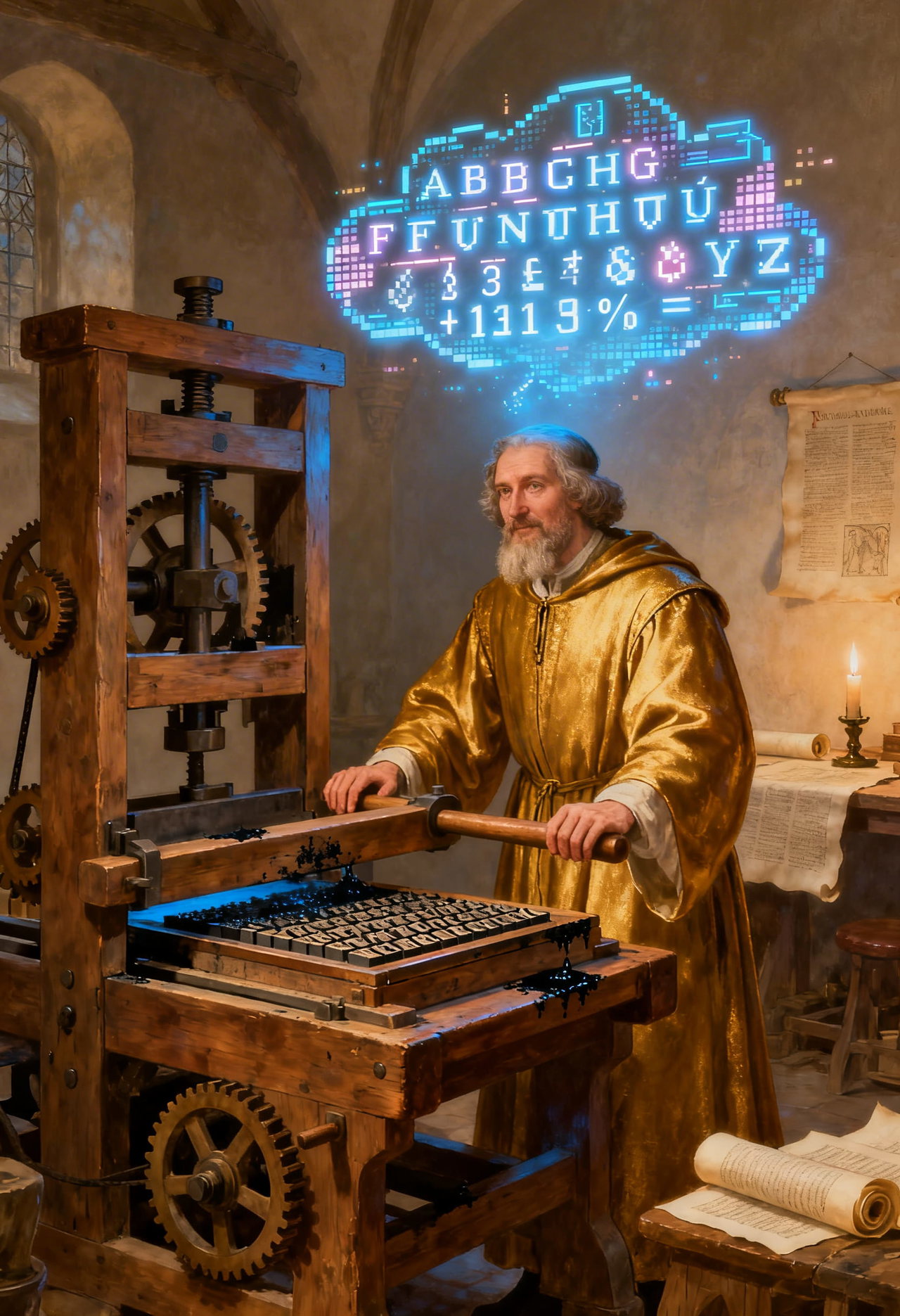
AI's impact on the written word is vastly overstated
Disruption in text production and publication is all but new, states thought leader Byrne Hobart
Foto/Video: Freepik
In this opinion piece, Byrne Hobart pushes back against a familiar fear: that AI-generated text will shatter trust in the written word. His argument is not that generative AI is trivial, but that we have seen disruptive shifts in textual culture before—from the printing press to blogs to spellcheck—and survived them. Cheap, abundant text has always changed how authority, credibility, and attention work. What matters, Hobart suggests, is not the existence of more text, but the filters we use to decide what deserves our time. So why does he think AI will matter less than many people assume?
If you’ve spent much time in online discussions of LLMs, you’ve probably encountered references to how we’ll need the text equivalent of low-background steel. It’s a fun analogy: ever since the development of nuclear weapons, metals have been contaminated with fallout, so for a while any piece of equipment that needed to be sensitive to radiation had to be constructed from pre-war steel. (Apparently not so big a problem anymore as the level of background radiation has declined—more on this later.) The argument was that we’d have the same problem in text: the only way to really trust that something was written by a trustworthy human source rather than some algorithm guessing the next word based on statistical distributions. The cost of machine-produced text is orders of magnitude lower than the old-fashioned kind, and soon enough, we won’t be able to trust anything we read.
I disagree. AI is a big deal in many fields, but for this particular issue—reducing the level of trust we have in the written word, and making it harder for all of us to have some sort of shared reality—it ranks well below the printing press, and probably closer to, and best compares to, blogs and spellcheck.
Cheap text has always raised the truth problem
The printing press is actually a good example of why the impact of cheaper writing and distribution on the truth is ambiguous. The pre-printing press economics of publishing were dominated by the cost of laboriously hand-copying individual works. This had a few impacts:
Raising the cost meant that the books that made sense to write were the ones with high, certain demand. That meant lots of religious texts, some classics of philosophy, the Canterbury Tales etc. One of the most popular non-religious books of the pre-printing press era—with perhaps as many as a thousand copies in print—was The Travels of Sir John Mandeville. This is a bit like Marco Polo’s stories, with a heavy helping of plagiarized fiction.
Raising this cost also meant that the marginal cost of making the books look nice was lower. If you’re waiting six months for someone to finish your copy of the New Testament, does it really make a difference to wait seven months and see some more decorative flourishes in the text?
Newly printed books had lower production values, because of that marginal cost argument. But there were many more of them, which made it more likely that a Mandeville reader would recognize sections cribbed from Pliny, or note that Marco Polo’s descriptions of China sound a bit more plausible, albeit less fun. Scarcity of text encourages writers to spend more time figuring out what’s really true, but it also means that compelling lies have less competition.
From pamphleteers to bloggers: the long history of independent media
If you look at the media environment once printing was established, it actually feels quite familiar: Daniel Defoe of Robinson Crusoe fame was an avid political pamphleteer, including a piece suggesting the mass execution of religious dissenters in England (the scholarly consensus is that he’s doing what, in modern parlance, we’d call a bit. Like many people on Twitter today, he posted it anonymously, got outed, and found himself in big trouble as a result.) He also wrote ghost stories, foreign policy tracts, opinionated pieces on the money supply etc. He was, in other words, what you’d refer to as a “blogger” in the 2000s and a “Substacker” more recently: someone with few or no institutional affiliations, who publishes opinionated pieces on a wide range of subjects.
That type has existed in some way since the dawn of mass media, but its importance varies. There’s a narrative that the US media environment started getting more fractured in the 1980s, and has continued in that direction to the present, but it’s really tracking a cycle. The US media environment of the mid-twentieth century was surprisingly consolidated: there were only a few national papers of note, all of which were ostensibly focused on a specific location like New York, Washington, or Wall Street. (USA Today didn’t launch until 1982); there were, famously, the big three TV networks; newspapers were increasingly monopolies; the cable TV buildout was early; and while AM radio’s shift from music to talk was underway, the Fairness Doctrine still meant that there were inconvenient features of talk radio—a station with a hit conservative show needed an offsetting progressive one, and vice versa, so it was hard for anyone to build a political brand that had any real appeal to just one group.
Blogging didn’t break the system—it rewired it
All of this was already changing before the Internet got big, but blogging was a qualitatively different change. In general, important decisions get made on the basis of one-on-one conversations, small group discussions, and the written word; very few important people get most of their ideas from TV or radio. That meant that in the pre-Internet ecosystem, people got daily printed news from a comparatively small set of sources, could read the long tail of ideas in books, and had something in between in magazines—a little less timely than newspapers, but feasibly a little longer than books. (The decline of the magazine has been invisible, but it’s a big deal: Liar’s Poker, The End of History and the Last Man, and the entire gonzo genre were all born in magazine form; both Vannevar Bush and Rachel Carson influenced public policy through magazine pieces./1/
Blogs occupied a niche that was faster than a daily paper, less editorially controlled than newspapers or magazines, and with zero barriers to entry. It turned out that some of the old media had been coasting on high production values and not investing enough in the valuable complementary good of having an accurate mental model of the world and updating it according to new information. Blogging was a curiosity for a while. The New Yorker covered the phenomenon early, in a piece that treated it as a novelty: “[W]hen you find an article or a Web site that grabs you, you link to it—or, in weblog parlance, you “blog” it. Then other people who have blogs—they are known as bloggers—read your blog, and if they like it they blog your blog on their own blog.” One of the subjects of the article did, of course, blog it, though this was so long ago that [when one of the subjects of the article inevitably blogged about it, he linked to NewYorker.com and told his readers the cover date and page range—why would you expect a magazine article to have a hyperlink?
What blogging meant was that people could participate in the discourse, in the medium that the most influential people prefer, without any vetting whatsoever. They could win by being first, if a story developed just after the paper hit the presses. They could indefinitely extend their own deadlines if the piece needed it. For a while, blogging coexisted with the media, free-riding a bit on reporting but getting stories more distribution. Bloggers mostly weren’t flying off to exotic locations to provide on-the-ground coverage of coups and famines, but they were finding those stories and making them famous. When blogging started to get serious blowback from the mainstream media, it was for actually breaking news, albeit of the news-about-the-news variety: CBS ran a story about George W. Bush’s National Guard record, the linchpin of which was a memo, ostensibly written in 1973 by Bush’s commanding officer, that turned out to be made in Microsoft Word. Since blogging is, intrinsically, an act of media analysis wrapped in media itself, this was the perfect story—there’s a very reasonable case that George W. Bush did shirk his obligations (or, if not, that he was uncommonly patriotic for a rich kid with an influential dad and no discernible interests other than partying). But CBS had messed up, and bloggers were able to respond to their defenses faster than they could come up with new ones. The blogosphere claimed a scalp in the form of Dan Rather’s resignation from CBS, but they also got a memorable pejorative from the CEO of CNN: “It’s an important moment, because you couldn’t have a starker contrast between the multiple layers of checks and balances, and a guy sitting in his living room in his pajamas writing what he thinks.”/2/ It was a big change for a story to be driven almost entirely by independent media: I. F. Stone, an independent newsletter writer, was the first journalist to point out that the Gulf of Tonkin incident didn’t particularly add up, but this didn’t have an impact until the story was picked up by mainstream outlets.
Pajama-clad or not, bloggers stuck around, and they forced other news organizations to adapt to their norms. Now, it’s common for stories to be posted quickly and then repeatedly edited; traffic gets measured and talked about even if it’s not a journalist’s only performance indicator; major media companies make fewer pretensions to partisanship as a result of competing against independent writers who made no attempt whatsoever to disguise their biases; and blogging melded with the establishment so seamlessly that there are writers today who broke into the lucrative and important business of mainstream media by blogging (e. g. Matt Yglesias) and bloggers who used their mainstream media fame to break into the lucrative business of independent publishing (e. g. Matt Yglesias). In retrospect, the logistics of printing a couple million copies of the same set of text and delivering it by truck should not have determined the entire structure of the prestige news business, but they did, until they didn’t.
Whether we like it or not, we live in a post-blogging world. But there are smaller-scale ways that textual technology has had a big impact, like spellcheck. Before spellcheck existed, one trivial heuristic for deciding what online posts to ignore or not was to ask a few simple questions, like: does this person know the difference between “there” and “they’re”? Do they end interrogative sentences with question marks? Are they, in short, basically literate? In one-on-one communications, this heuristic breaks down, because the best way to tell how high someone is in a corporate hierarchy is how often they use constructions like “thx,” but in a one-to-many environment, proper spelling and grammar were proof-of-work: either this person not only wrote a first draft, but literally went through the heroic process of rereading it to see if they’d made any mistakes, or this person is so textual, both in terms of their input and their output, that they naturally produce basically perfect first drafts. Either way, it was an easy-to-spot signal that made triaging writing by unfamiliar people easier.
Tools like Grammarly take this a bit further, and at this point LLMs make it so that everyone who wants to can write whatever email they need to in whatever tone they want (yes, you can use ChatGPT to Chad up your work emails by removing all of the apologies and clarifications). This can move writing a little closer to 90th percentile, when it’s being used by someone who could produce the same result if they were a bit more diligent. But it can also elevate basically any coherent thought into a message that reads like it was produced by a college-educated professional./3/
Eliminating the ability to judge people based on how well they write is a social shift that, at least for the Extremely Online, is an act of linguistic egalitarianism on par with the abolition of the thou/you distinction. It’s a huge deal if you can’t quickly and superficially judge a text based on those signifiers, and instead have to engage with the ideas before dismissing them as worthless.
Why AI text won’t overwhelm us the way people fear
To handle this, we end up using some combination of algorithmic feeds and opt-in subscriptions. There is far more content being written online than anyone can consume, even if they narrow the scope to their interests. And this is why generative AI won’t be that big a deal for text: there’s already an effectively unlimited supply of people who are writing completely deranged things but can present them with the same design standards and theoretical distribution as a major media outlet (blogging! Substack!) and the same text-level production values, too (spellcheck!). We already implicitly opt out of the overwhelming majority of what we could read. And whether we read .01 % or .001 % of what theoretically interests us doesn’t make much of a practical difference. After all, we can only consciously process 10 bits of information per second, which amounts to ~2gb in an average lifetime, so we have to opt in wisely.
Published by courtesy of The Diff/Byrne Hobart.
Though there does seem to be a modern resurgence being born out of the new media world: both Palladium Magazine and the Colossus Review are trying to revive this spirit.
I was personally excited about this whole kerfuffle back in 2004, not because I had strong opinions on George W. Bush or John Kerry’s military records, but because I had pajamas, opinions, and an Internet connection.
The AI content of The Diff probably hovers at around the 0.1 % mark for text, though AI's share of research is a lot higher and still rising. That 0.1 % does not consist of any ChatGPT-generated text; it’s actually because one of the steps in the writing process is dumping the text into Google Docs, because Docs is a shared editor and has such good contextual spelling and usage checking, which has been powered by a deep learning model since at least 2021. (In a reflection of just how fast things have advanced: the model has 680 m parameters and is described as “a very large model.”).

Byrne Hobart (LinkedIn profile page): Investor, consultant, and writer focused on finance and technology. Author of ‘The Diff’ newsletter and co-author of ‘Boom: Bubbles and the End of Stagnation.’